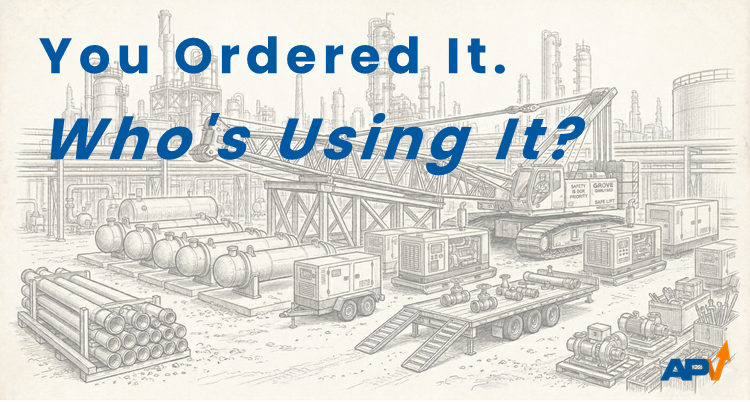
You Ordered It. Who's Using It?
Written on: March 30, 2026
Equipment mobilization looks simple on paper. You need a crane, you order a crane, the crane shows up. Done.
Except it's never that simple. The gap between "ordered" and "productively utilized" is where turnaround budgets go to die.
I've watched this play out from both sides: as an owner wondering why three 20-ton cranes are on site when the plan called for two, and as a contractor watching my crew stand idle because the crane I was promised is tied up on another work face with no clear release time.
The equipment shows up. The invoices show up. The coordination? That's where things fall apart.
The Scenario Nobody Planned For
Planning specifies the equipment needed to perform the work in each package. Scheduling ensures those resources are optimized and aligned with the approved schedule. Procurement converts that into orders. The rental company delivers. So far, so good.
Then execution starts. The schedule shifts. Unit 2 falls behind, Unit 3 pulls ahead. The carefully optimized resource plan that scheduling built is now running against a reality that looks nothing like the baseline. Contractor A needs the crane assigned to Contractor B. Contractor C ordered their own crane because nobody told them one was already available, and frankly, waiting on an answer takes too long anyway.
Now you have three cranes on site. One is sitting idle, waiting for a work face that isn't ready. One is double-booked between two contractors who both believe they have priority. One showed up because of a communication gap nobody caught in time.
You're paying for all three. Depending on size and rigging configuration, crane rentals typically run $1,800 to $2,500 per day. Over a 30-day event, that's $54,000 to $75,000 per unit. When you're carrying one or two redundant cranes for the better part of an event, it's not hard to reach $100,000 or more in equipment cost that delivered zero productive value.
Why This Keeps Happening
The root cause is the same one that drives mobilization chaos and demobilization overruns: the handoff.
Planning and scheduling build the resource picture based on the approved plan. But the plan is a snapshot. The moment execution starts, reality diverges. Work faces shift, priorities change, and contractors make field decisions that never make it back to anyone with a full view of the event.
Nobody owns the real-time picture of what's on site, what's actively being used, and what's available for redeployment.
Planning and scheduling assume someone is tracking utilization. Controls assumes field coordinators are managing assignments. The coordinators assume they've been told everything they need to know. The contractors assume that if they need something, they're better off ordering it themselves than waiting for an answer that may never come.
The result: redundant equipment, idle equipment, and a closeout invoice that makes everyone ask the same question. Who approved this?
Three Things That Actually Work
Create a single source of truth for on-site equipment. Not three spreadsheets living in three different inboxes, but one list that shows what's on the yard, who has it, and when it's scheduled to release. Update it daily, without exception.
Route contractor equipment requests through the owner's coordinator before ordering. This isn't about creating bureaucracy. It's about catching duplication before it hits the event. If a 50-ton crane is already on site and releasing on Thursday, you may not need to mobilize another one for Friday's scope.
Track utilization against billing. If a piece of equipment is invoiced for 30 days but the work log reflects 18 days of productive use, that's a conversation worth having before closeout, not two months later, when the contractor is long gone, and the documentation has gone cold.
Equipment coordination isn't complicated. But it requires someone to own the picture, and it requires that picture to update as fast as the work changes.
This is part of what we're building visibility around with MODEMO®. Not just people, but the full picture of what's on site and whether it's producing value.
John Crager is Vice President and General Manager at APVantage LLC. He has spent more than 30 years in industrial maintenance, capital project, and turnaround operations.
#APVantage #MODEMO #turnaround #maintenance #STO