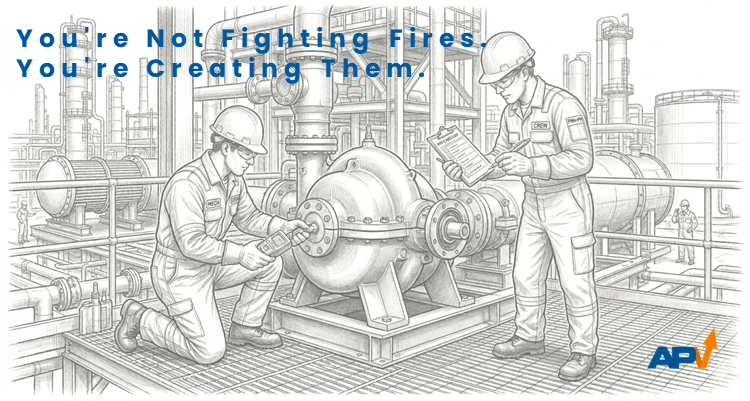
You're Not Fighting Fires. You're Creating Them.
Written on: April 14, 2026
After more than 30 years in industrial maintenance, capital projects, and turnaround operations, I've watched the same pattern play out at plant after plant. The routine maintenance program is running. Work orders are being opened. Crews are busy every single day. And reliability is still eroding.
Not because the people are wrong. Because the work is wrong.
Somewhere along the way, planned and scheduled work gave way to reactive and scrambled, one deferred PM at a time, until firefighting felt like normal operations. I've seen it happen at refineries, petrochemical facilities, and large manufacturing sites. And it's almost always the same trap.
Where the Firefighting Trap Actually Lives
Turnarounds get planned. Capital projects get managed. But routine maintenance? That's where the culture gap shows up every single week.
Here's what it looks like in practice. A pump trips at 6 AM. The crew drops the planned lubrication route and responds. The next day, a heat exchanger starts showing vibration, so the scheduled valve inspection slides again. By Friday, the weekly plan is unrecognizable. PM compliance for the week comes in at 55%. Everyone's exhausted from a week that felt productive but produced almost none of the prevention work that was actually scheduled.
Reactive maintenance in the run-and-maintain environment costs two to five times more per work order than planned work (Micromain, 2023). That gap compounds weekly. Deferred PMs become the failures that fill next week's emergency queue. The cycle feeds itself.
What makes it so stubborn is that it rewards the wrong behaviors. The technician who restores the failed pump at midnight gets recognized. The crew that quietly completed every PM on the lubrication route gets nothing. I've seen that dynamic kill proactive programs that had strong executive support and solid procedures behind them. Until organizations flip that recognition pattern, the culture won't shift no matter what the CMMS reports say.
Culture Change Isn't a New Work Order Template
In my experience, most plants try to fix routine maintenance by updating procedures, retraining on the CMMS, or adding a new priority code. Those aren't wrong. But they fix the wrong layer.
Real culture change in routine maintenance requires three things. Leadership has to treat PM compliance as a business metric, not just a maintenance metric. Supervisors and crews have to understand why today's deferred PM creates next week's failure, not just that leadership wants better numbers. And the conditions for execution, parts staged, permits arranged, windows protected, have to actually exist before the work is scheduled.
Miss any one of those three and the behavior doesn't change. The training fades. The old patterns come back fast.
My recommendation is always the same: start with one unit. Run a focused pilot. Make PM compliance visible at the crew level, not just the plant level. Early, specific wins build internal credibility faster than any policy rollout can.
What the Numbers Are Actually Telling You
Metrics in routine maintenance serve two purposes. They measure progress, and they signal what leadership values. Posting PM Compliance in a monthly report that nobody acts on teaches teams the number is informational. Reviewing it weekly alongside production throughput teaches something very different.
Watch these as your leading indicators:
- · PM Compliance Rate: Scheduled routine tasks completed on time. The benchmark worth chasing is 90%. A rate below 70% usually means the weekly schedule isn't being protected, not that the work can't be done.
- · Planned Maintenance % (PMP): Target 70 to 80% of total routine work orders being planned rather than reactive. A falling PMP is usually the first visible sign the firefighting cycle is accelerating.
- · Reactive Maintenance %: Keep emergency work below 20 to 30% of total routine work orders.
- · Break-in Rate: How often does unplanned work displace the weekly routine schedule? A rising break-in rate predicts a PM compliance decline within weeks.
PM Compliance is the most honest early signal of culture. A healthy routine program completes scheduled tasks within 10% of the planned interval. If yours is sitting at 60%, the schedule isn't the problem. The culture around protecting the schedule is.
The Bottom Line
Building a proactive culture in routine maintenance isn't about eliminating every emergency. Equipment fails. Real emergencies happen. The goal is making them rare enough that the planned work actually runs.
Plants starting from a reactive baseline should plan for two to four years of sustained effort, with early wins visible within six months when a focused unit pilot is structured correctly. The plants that make it through aren't the ones with the best CMMS or the most updated procedures. They're the ones where leadership stayed committed past the first quarter, early wins were made visible, and prevention got recognized as loudly as response.
That shift happens in routine maintenance. Week by week. Work order by work order.
John Crager is Vice President and General Manager at APVantage LLC. He has spent more than 30 years in industrial maintenance, capital project, and turnaround operations.
APVantage helps industrial organizations optimize their maintenance execution practices by helping teams not only understand the problem but develop solutions that actually fit their unique situations.