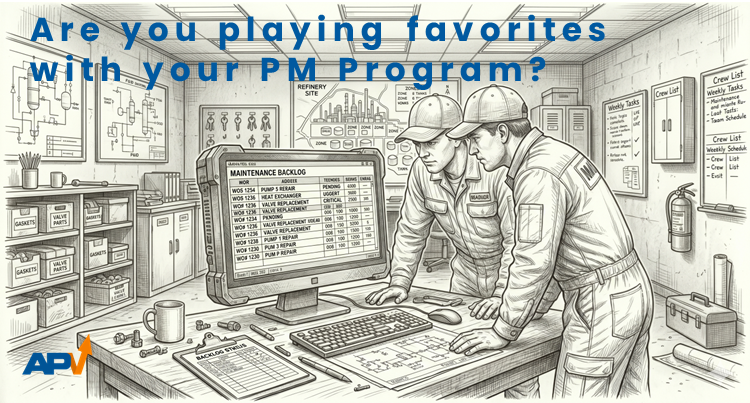
Are You Playing Favorites With Your PM Program?
Written on: May 05, 2026
Walk through any facility that's been running for more than five years and ask the maintenance team which assets get the most attention. They'll tell you fast. The big rotating equipment everyone knows by name. The compressors that tripped last year. The pump train the plant manager walked past during that one bad week.
Then ask which assets get the least attention.
That answer takes longer. Not because they don't know. Because they do, and it's uncomfortable. It's the heat exchangers nobody has touched since the last turnaround. The instrument loops that haven't been calibrated because they've never caused a problem. The secondary systems that run quietly in the background until they don't.
Every PM program drifts toward its favorites. The assets that are visible, that have histories, that have advocates. And it drifts away from the ones that are quiet. Until quiet becomes failure, and failure becomes an emergency that nobody saw coming because nobody was looking.
How Favorites Develop
PM programs don't start with favorites. They start with a criticality ranking, an asset register, and a set of maintenance frequencies built on engineering logic. For a window of time, usually right after a major program refresh or a new CMMS implementation, they run roughly as designed.
Then reality sets in.
A critical pump trips at 6 AM. The response team restores it. Leadership notices. The PM frequency on that pump gets increased. The technician who owns that area becomes expert on it. Nobody questions the attention because the consequences of failure are obvious.
Meanwhile, the static equipment in the adjacent area keeps running. The vessel that's been in service for eighteen years. The heat exchanger with insulation that hasn't been inspected since the Obama administration. Quietly. No trips, no alarms, no escalations. No advocate.
Quiet assets don't generate attention. They don't generate work orders that get flagged, problems that get escalated, or champions who push for their PM frequencies to be reviewed. They generate baseline assumptions: it's been fine, it'll stay fine.
That assumption is where the favorites problem lives. It compounds every year the PM program drifts further from its original criticality basis.
The Three Drift Patterns to Watch
Recency bias. Assets that have failed recently get more attention than assets that are statistically overdue for failure. The last failure is vivid and memorable. The next failure, the one building quietly in a system that hasn't tripped in four years, is invisible. PM programs shaped by recency bias are reactive programs with a proactive label.
Visibility bias. High-traffic areas, frequently inspected units, and assets near control rooms and walkways get more informal attention than remote, low-traffic systems. Technicians notice what they walk past. Nobody notices what they never walk past. The geography of your facility quietly shapes your maintenance coverage. It almost never maps to your criticality ranking.
Ownership bias. Assets with a dedicated owner get consistent, attentive maintenance. A technician who knows them personally. A supervisor who's worked them for years. Assets that fall between organizational boundaries, that are technically everyone's responsibility, get maintained by nobody in particular. In practice, shared ownership is no ownership.
None of these drift patterns require negligence or bad intent. They're the natural product of a busy maintenance organization operating under time pressure without a systematic mechanism to check whether attention is actually tracking criticality.
What a Criticality Audit Actually Reveals
Most facilities believe their PM program is criticality-based because it was when it was designed. A criticality audit is a structured review of actual PM execution against the criticality ranking. What it typically reveals is something different.
The highest-criticality assets are being maintained at or above their planned frequency. No surprise there. The moderate-criticality assets show mixed results. Some well-maintained. Some quietly deferred. And then there's a category that shows up in almost every audit: assets with low recent PM activity, no recent failures, and a criticality classification that hasn't been reviewed in years.
Those assets fall into one of two buckets. Either they're genuinely low-criticality and the PM frequency is correctly minimal, in which case the program is working as designed. Or they're low-criticality on paper but high-consequence in reality, because the original classification is outdated, the process conditions have changed, or the downstream impact of failure wasn't fully understood when the ranking was set.
That second bucket is where facilities get surprised. Not by the assets everyone was worried about. By the ones nobody was thinking about at all.
Three Things That Reset the Drift
Run a criticality review on a defined cycle, not on a failure trigger. Most facilities revisit criticality rankings after something fails, which means the review is always one failure too late. A PM program that runs a formal criticality review every two to three years, independent of failure history, catches the drift before it becomes consequence.
Cross-check PM completion against criticality ranking, not just against plan. If your reporting shows PM compliance as a plant-wide percentage, it's masking what's happening at the asset level. A 90% PM compliance rate looks strong until you see that the 10% non-compliance is concentrated in your highest-criticality assets. Or that your lowest-criticality assets are consuming three times their planned maintenance hours while critical systems slide.
Make invisible assets visible. Route reviews, walk-down schedules, and PM route design should be deliberately structured to put eyes on low-traffic, low-history assets at a frequency that matches their criticality, not their recent event history. Visibility is a maintenance resource. Allocate it the same way you allocate craft hours.
The Culture Dimension
There's a reason the firefighting trap and the favorites problem tend to appear in the same facilities. Both are rooted in the same cultural dynamic: organizations that respond loudest to visible, immediate problems and quietly deprioritize the prevention work that doesn't generate urgency.
The technician who restores the failed pump at midnight gets recognized. The technician who systematically worked down a PM route on low-profile static equipment, assets that won't fail this week because the maintenance ran, gets nothing. Until the PM culture visibly values the prevention work on the unglamorous assets, the drift toward favorites will continue no matter what the criticality ranking says on paper.
This is the layer that procedure changes and CMMS updates don't reach. The program can be redesigned around criticality. The behavior won't follow until the organization recognizes criticality-based discipline as loudly as it recognizes crisis response.
The Bottom Line
Your PM program has favorites. Every program does. The question isn't whether the drift exists. It's whether your organization has a mechanism to see it and correct it before a quietly degrading asset makes the decision for you.
The assets that will surprise you in 2027 aren't the ones you're worried about today. They're the ones nobody's thinking about at all.
John Crager is Vice President and General Manager at APVantage LLC. He has spent more than 30 years in industrial maintenance, capital project, and turnaround operations.
APVantage helps industrial organizations optimize their maintenance execution practices by helping teams not only understand the problem but develop solutions that actually fit their unique situations.