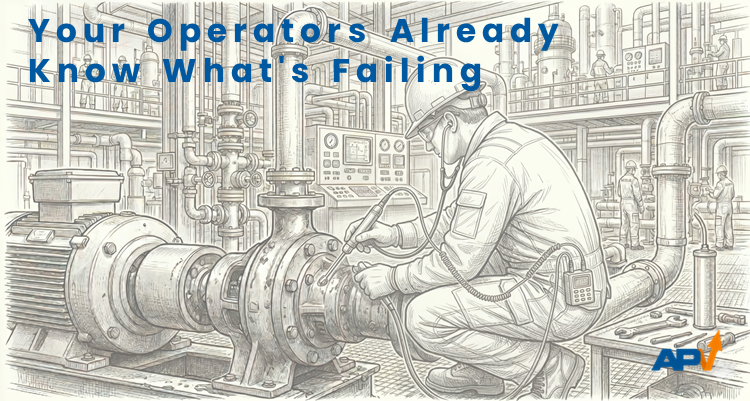
Your Operators Already Know What's Failing
Written on: May 11, 2026
Walk into any unit at any plant in the country and ask the operator running it which piece of equipment is going to fail next. They'll tell you.
They might not say it that directly. They'll mention the pump that's been making a different sound since Tuesday. The seal that's seeping just a little more than last week. The exchanger outlet temperature that's drifting two degrees off where it used to sit. They've been standing in front of that equipment for years. They know it the way you know your own car.
The question is whether your maintenance program is structured to hear what they're already saying.
In my experience across refineries and chemical plants, the gap between what operators notice and what makes it into the work order system is one of the largest sources of avoidable downtime in our industry. Closing that gap is what Operator-Performed Maintenance is actually about.
Why Operators See It First
No vibration sensor, infrared camera, or predictive analytics package replaces an operator who's been on a unit long enough to recognize when something feels off. Sensors catch what they're calibrated to catch. Operators catch the small, drifting, off-baseline conditions that don't trip an alarm but absolutely predict a failure six weeks out.
That's not romantic talk about gut feel. It's pattern recognition built over years of exposure. The pump that's running hotter than the identical pump next to it. The discharge line that's vibrating in a way it didn't last shift. The control valve that's hunting more than it should be. Operators see these things first because they're physically present and contextually aware in a way that no instrument is.
The problem is that most facilities have no structured mechanism to convert what operators notice into action. The observation lives in the operator's head, gets mentioned to a supervisor who's already overloaded, and never makes it to a work order. Six weeks later, the failure happens. And nobody connects it back to the operator who saw it coming.
Operator-Performed Maintenance closes that loop. It formalizes the operator's role in early defect detection, gives them a structured way to capture findings, and feeds those findings directly into the maintenance work management system where they can actually be acted on.
What OPM Actually Looks Like
OPM isn't handing an operator a grease gun and calling it a program.
A real program has a few specific elements. Defined task lists by equipment type that match what an operator can safely and competently do. Skills qualification and sign-off so that the operator and the organization both know what each person is authorized to perform. Integration with the CMMS so that operator-generated findings become work orders, not sticky notes. And accountability metrics that recognize participation, so operators see that the work is valued.
The task lists matter more than people think. An OPM program that asks too much of operators sets them up to fail and creates safety risk. One that asks too little leaves the value on the table. The right scope is usually narrower than enthusiasts want and broader than skeptics will accept. Finding it takes deliberate work with operations, maintenance, and safety at the table together.
The Wall That Has to Come Down
There's a reason OPM is harder to implement than it looks on paper. Most facilities have spent decades reinforcing a hard boundary between operations and maintenance. The wall exists for historical reasons. Union jurisdictions, safety boundaries, accountability structures, and in some cases plain organizational habit.
OPM doesn't ask anyone to abandon those structures. It asks the organization to find the space where operator involvement adds reliability without compromising the boundaries that exist for good reasons.
That conversation is uncomfortable in a lot of plants. It's also unavoidable if reliability is actually the goal. The facilities that have built effective OPM programs didn't do it by ignoring the operations-maintenance boundary. They did it by mapping that boundary deliberately, identifying the high-value tasks where operator ownership clearly improves outcomes, and building the qualification and accountability structures to support operators doing that work safely.
This is culture work, not procedure work. It moves slowly. It only moves when leadership stays committed past the first round of pushback.
The Turnaround Connection
For turnaround-driven organizations, OPM has a benefit that often gets missed. It directly reduces turnaround scope uncertainty.
When operators are performing structured inspections and documenting findings throughout the run cycle, your planners arrive at scope development with real data instead of assumptions. The vessel that needs internal inspection. The exchanger that's been trending toward fouling. The control valve that's been hunting for the last four months. These observations should be feeding the turnaround scope long before the pre-job planning phase starts.
Without OPM, that data either doesn't exist or lives in a dozen different operator notebooks that the planner never sees. Scope gets built on assumptions and last-turnaround precedent. The discovery work piles up once the blinds come out. Costs go up. Schedules slip.
I've seen plants cut their discovery scope significantly by simply starting to capture and channel what their operators already knew. That's not a transformation story. It's a connection story. The information was always there. Somebody just had to build the pipe between operations and planning.
The Bottom Line
The most underused reliability asset in most facilities isn't a piece of equipment or a software platform. It's the operator who's been running a unit for fifteen years and knows it the way you know your own house.
OPM isn't about replacing maintenance with operations. It isn't about cutting maintenance headcount. It's about formalizing the role operators are already playing informally, capturing the information they're already generating, and connecting it to the maintenance work that protects runtime and reduces turnaround surprise.
The equipment is already telling you what it needs. The operator is already hearing it. The only question is whether your program is structured to listen.
John Crager is Vice President and General Manager at APVantage LLC. He has spent more than 30 years in industrial maintenance, capital project, and turnaround operations.
APVantage helps industrial organizations optimize their maintenance execution practices by helping teams not only understand the problem but develop solutions that actually fit their unique situations.